

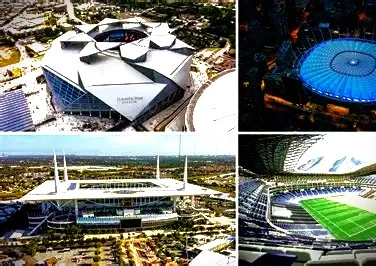
Excitement is building for the World Cup 2026 as Canada, Mexico, and the United States co-host and promise more matches, fans, and iconic stadiums.
In this guide, we explore the legendary arenas that will define the 2026 FIFA World Cup and what sets each host location apart. Let’s begin by looking at the countries that will bring this tournament to life.
An Overview of the 2026 FIFA World Cup Hosts
The FIFA World Cup 2026 will feature 48 teams competing across 16 host cities. This unprecedented scale requires top-tier infrastructure, leading to the selection of 11 stadiums in the USA, 3 in Mexico, and 2 in Canada.
Key Highlights:
- Opening Match: The historic Estadio Azteca in Mexico City.
- The Final: MetLife Stadium (New York/ New Jersey Stadium)
- Semi-Finals: Dallas (AT&T Stadium) and Atlanta (Mercedes-Benz Stadium).
The Iconic Stadiums of World Cup 2026
- 1. The Giants of the United States
- The U.S. will host the majority of the matches, utilizing state-of-the-art NFL stadiums that have been adapted for world-class soccer.
- MetLife Stadium (New Jersey): With a capacity of over 82,000, this stadium is set to host the final. It’s a crown jewel of the 2026 World Cup. AT&T Stadium (Dallas): Known as “Jerry World,” this massive indoor arena can expand its capacity to nearly 100,000, making it a prime spot for the semi-finals.
- 2. The Historic Venues of Mexico
- Mexico brings a deep football tradition to the FIFA World Cup 2026.
- Estadio Azteca (Mexico City): The first stadium to host three World Cups. It’s where legends like Pele and Maradona cemented their legacies.
- Estadio BBVA (Monterrey): Nicknamed “The Steel Giant,” it offers one of the most picturesque mountain views in world football.
- 3.Canada’s Growing Football Scene
- Canada will host its first-ever men’s World Cup matches in two vibrant cities.
- Bc Place (Vancouver): A beautifully renovated stadium with a retractable roof, located in the heart of British Columbia.
- BMO Field (Toronto): Undergoing expansion to meet FIFA standards, ensuring a passionate atmosphere for North American fans.
Why the 2026 FIFA World Cup is Different?
The shift to a 48-team format means the World Cup 2026 will be a football festival like no other. The travel distances between cities like Vancouver and Mexico City will pose a unique challenge. Still, the diversity of cultures and the quality of the FIFA World Cup 2026 stadium will make it an unforgettable experience for every spectator.